
Winn Parish Projected Versus Actual
A projected release date is a conditional calculation. It starts with the sentence and can reflect credit for prior custody, earned diminution of sentence, sentence structure, and other rules. “Diminution” means a lawful reduction in time to be served, often called good time. The date remains projected because later court action, loss or restoration of credit, parole decisions, or another agency's hold can change the result. The actual release date records when the custodian truly ended physical custody.
Pretrial custody works differently. A person waiting for trial has not received a sentence that can be reduced to a fixed end date. Bond, dismissal, plea, conviction, a release order, or a transfer may end that stay. Even when the Eighth Judicial District Court issues an order, jail processing and an independent detainer can delay physical release. A detainer is another agency's request or basis to hold or take custody of the person.
Scheduled versus actual: A Winn Parish projected date is a planning estimate. The jail or DPS&C discharge entry is the proof of what occurred.
The distinction is also vital after transfer. Leaving Winn Parish Detention Center for Louisiana DPS&C is not release from the state sentence. Likewise, a person leaving predominantly ICE-operated Winn Correctional Center may have transferred, been removed, or entered another custody status rather than returned to the community.
Find Winn Parish Projected Dates
The Louisiana Department of Public Safety and Corrections publishes a clear telephone route for a state prison projection. Call the Imprisoned Person Locator at 225-383-4580 with the DPS&C number. If that number is not known, provide the person's name and date of birth. DPS&C says the response can include a facility assignment, facility contact information, and a projected release date if one applies. Its public web guidance does not promise that every VINELink result displays this field.
For a local sentence at Winn Parish Detention Center, ask the sheriff for the sentence-computation or release-date entry. Then obtain the sentencing minute entry from the Winn Parish Clerk of Court. The court record should show the sentence, credit ordered for time already served, and whether multiple terms run at the same time or one after another. Do not apply state rates to partial facts and publish a homemade date.
- Identify whether the person is pretrial, serving a parish sentence, or assigned to Louisiana DPS&C.
- Gather the full name, date of birth, court case number, and DPS&C number when one exists.
- For state custody, call the DPS&C locator and record the date and time of the projection.
- For a parish sentence, request the jail's computation entry and the court's sentencing minute.
- Ask whether the date reflects full term, good time, parole action, or another calculation.
- Recheck the proper custody system on or after the projected date and obtain the actual release or discharge entry.
The official DPS&C inmate-information page shows the locator route and the limits of public sentence information.
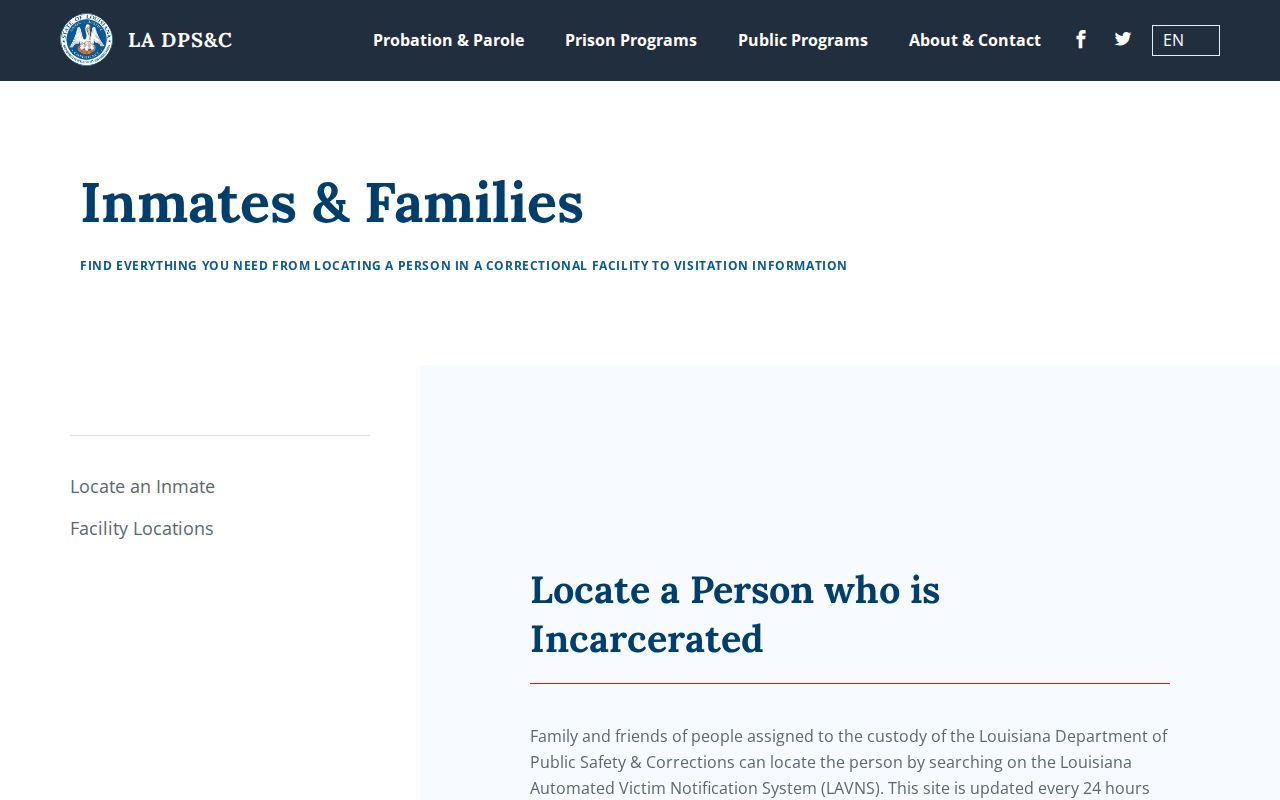
This state source supports a telephone projection for an eligible Louisiana prisoner, not a promise that every web search will display a date.
Note: When sentencing papers have not reached DPS&C, an official state calculation may not yet be available.
Winn Parish Custody Controls
The building does not always identify legal custody. A person sentenced to DPS&C can remain physically housed in a parish facility. The parish roster may later remove the name when DPS&C moves that person, but the move does not establish state discharge. Follow the legal custodian named in the booking, court, or transfer record. State prisoners use the DPS&C locator, LAVINE status, and the public discharge-date request.
A municipal case may begin at Winnfield City Jail and move to Winn Parish Detention Center. The city holds its own booking and release records, while the parish holds its records. A county sentence should be checked with the sheriff and the Eighth Judicial District Court. Winn Correctional Center requires a different first question: most of its current capacity serves ICE detention, while only a small state-offender component remains. ICE detention does not use Louisiana criminal good-time calculation as its release-date system.
| Custody type | Where the date comes from | Best final proof |
|---|---|---|
| Pretrial parish detainee | Usually no fixed projected date; court and bond events control | Court authority plus jail release or transfer entry |
| Sentenced parish inmate | Sheriff computation and sentencing minute | Actual jail release entry |
| Louisiana state prisoner | DPS&C Imprisoned Person Locator | DPS&C public discharge date |
| ICE detainee at Winn | Immigration case and ICE channels, not a Louisiana sentence projection | ICE or immigration case record |
That custody split prevents the most common local error: treating a roster disappearance, facility move, or court date as the end of all custody.
Louisiana Good Time Is Conditional
Louisiana Revised Statute 15:571.3 sets the core good-time framework. For a person convicted and sentenced to parish prison without hard labor, subsection A can permit diminution, subject to statutory exclusions. The general eligible rate is 30 days of diminution for each 30 days in actual custody. That shorthand does not mean every 30 days automatically erase the next 30. Eligibility, conduct, sentence terms, and the applicable version of the law still control.
A different rate helps explain Louisiana's often repeated “85 percent” phrase. For an eligible first conviction of a crime of violence, the statute provides three days of diminution for every 17 days in actual custody. That corresponds to serving about 85 percent before that reduction where the provision applies. It is not a universal rule for every Winn Parish or Louisiana inmate. Offense classification, conviction date, prior violent history, habitual-offender status, sex-offense restrictions, and other exclusions can alter or bar the credit.
Louisiana Revised Statute 15:571.3 contains the controlling diminution rules and exclusions. The simple rates can explain a concept, but only the sheriff or DPS&C can apply them to a specific sentence.
- Good time
- Diminution that may reduce time served when the governing law and conduct requirements allow it.
- Full-term date
- The sentence end before a qualifying early-release calculation is applied.
- Jail credit
- Credit toward sentence for qualifying time spent in actual custody before sentence.
- Consecutive sentences
- Terms served one after another rather than at the same time.
This distinction is Winn Parish's assigned release-date computation angle: the 30-for-30 and three-for-17 rates are separate rules, and the latter is the source of the approximate 85-percent statement.
Winn Parish Jail Credit
Louisiana Code of Criminal Procedure article 880 governs credit toward a sentence for time spent in actual custody before sentence, subject to the article's terms. That credit can shift a projected date because part of the term may already have been served. The sentencing minute and commitment papers supply the legal basis, while the custodian applies the credit in its computation.
Multiple sentences add another layer. Concurrent terms run together, while consecutive terms run one after another. A later amendment, revocation, or corrected commitment can change the start point or sentence structure. Partial online docket text is not enough for a reliable calculation. Request the complete sentencing minute, the credit language, and the current agency computation instead.
The official text of article 880 explains Louisiana custody credit. It does not turn an unofficial public calculation into an agency release date.
Note: Ask whether all sentencing papers and jail-credit details have reached the custodian before treating a projection as current.
Winn Parish Release Date Changes
A projected date can move earlier or later. The reason should come from the custodian, court, or parole record, not guesswork. Ask what changed and when the new calculation took effect. The answer may be a credit event, a new court order, a sentence aggregation change, or a separate hold that does not alter the sentence end but blocks physical release.
Write down the old and new projections before asking for an explanation. The comparison helps the records office identify whether the change arose from sentence papers, earned-time accounting, a court event, or a separate custody issue.
| Factor | Possible effect | Record to check |
|---|---|---|
| Good-time loss or restoration | Moves the conditional date later or earlier | Current sheriff or DPS&C computation |
| Jail-credit correction | Changes credited time already served | Sentencing minute and computation entry |
| Concurrent or consecutive terms | Changes how multiple sentences combine | Commitment papers and agency calculation |
| Court amendment or revocation | Changes the sentence or custody authority | Eighth JDC minute entry or order |
| Parole action | May authorize conditional release after eligibility | Committee decision and DPS&C status |
| Detainer or hold | May prevent community release after one term ends | Holding agency and receiving-custodian record |
A person disputing a DPS&C computation must use the facility administrative-remedy process. Family or friends cannot file that grievance for the confined person. The public-records mailbox is for existing records, not sentence-computation disputes.
Parole Is Not a Date
Parole eligibility is distinct from good-time release. Louisiana Revised Statute 15:574.4 contains several categories based on offense, sentence, age, dates, and exclusions. Eligibility means the Committee on Parole may consider release. It does not promise a grant. A hearing date is merely a scheduled proceeding, and even a favorable ruling may be followed by conditions, processing, rescission, or an independent detainer.
Verify a grant through the actual committee decision, then check DPS&C custody status and the discharge record. If community supervision begins, the person may live outside prison while remaining under parole oversight. The Natchitoches District Office serves Winn Parish, but a supervision-office assignment does not state the physical prison release time.
Important: Eligibility, a hearing, a favorable parole decision, prison discharge, and the start of supervision are separate events.
Confirm Winn Parish Actual Release
Recheck the correct agency on or after the projected date. For Louisiana state custody, call the DPS&C locator again. LAVINE may show a custody change or community-supervision status, but the exact released-result web label was not independently verified. A focused DPS&C public-records request can seek the public discharge date, offense, conviction date, sentence length, and disposition information under La. R.S. 15:574.12(G)(1)(a).
For a parish sentence, request the Winn Parish Sheriff's release entry with the actual date and time, release reason, releasing authority, and destination or receiving agency when recorded. Pair it with the Eighth JDC disposition. If another authority took custody, continue in that system. For a pending custody-change alert, the Winn Parish VINELink check explains local LAVNS registration and its limits.
No projection should be reported as the final event. The reliable endpoint is the record created when the responsible custodian releases, transfers, or discharges the person.